
Why material, production, and elasticity determine quality—and why FLEXVIT consistently relies on Made in Germany
Why Quality is Crucial for Resistance Bands
In recent years, resistance bands have evolved from a supplementary training tool into an integral part of modern training systems. Today, they are used in rehabilitation, athletic training, physiotherapy, performance diagnostics, and functional strength training.
However, with this development, the importance of product quality also grows.
Resistance bands are not simply interchangeable training tools. Their properties directly influence:
- Movement quality
- Load control
- Safety
- Motor control
- Training transfer
Nevertheless, many products on the market differ considerably—both in their material quality and in their actual training behavior.
Against this background, FLEXVIT has pursued a clear objective from the outset:
We aim to develop the highest quality elastic resistance bands and to permanently replace classic rubber bands with more durable, safer, and functionally superior solutions.
This claim not only shapes our products but also the entire development and production process.
Why Classic Rubber Bands Often Reach Their Limits
Many conventional resistance bands are based on simple latex or rubber. These products are often cost-effective to manufacture but come with several disadvantages:
- Low durability
- Quick wear and tear
- Inconsistent stretch behavior
- Unpleasant feel
- Increased susceptibility to tears or material fatigue
Furthermore, many products use plasticizers to achieve certain material properties. These can affect material behavior and reduce aging resistance.
In practice, these differences often only become apparent after intensive use:
The band loses tension, reacts unevenly, or changes its resistance profile.
This is particularly problematic in professional training. Because there, it's not just about the presence of resistance—but about how that resistance works.
Quality Begins with the Material
FLEXVIT therefore pursues a different approach.
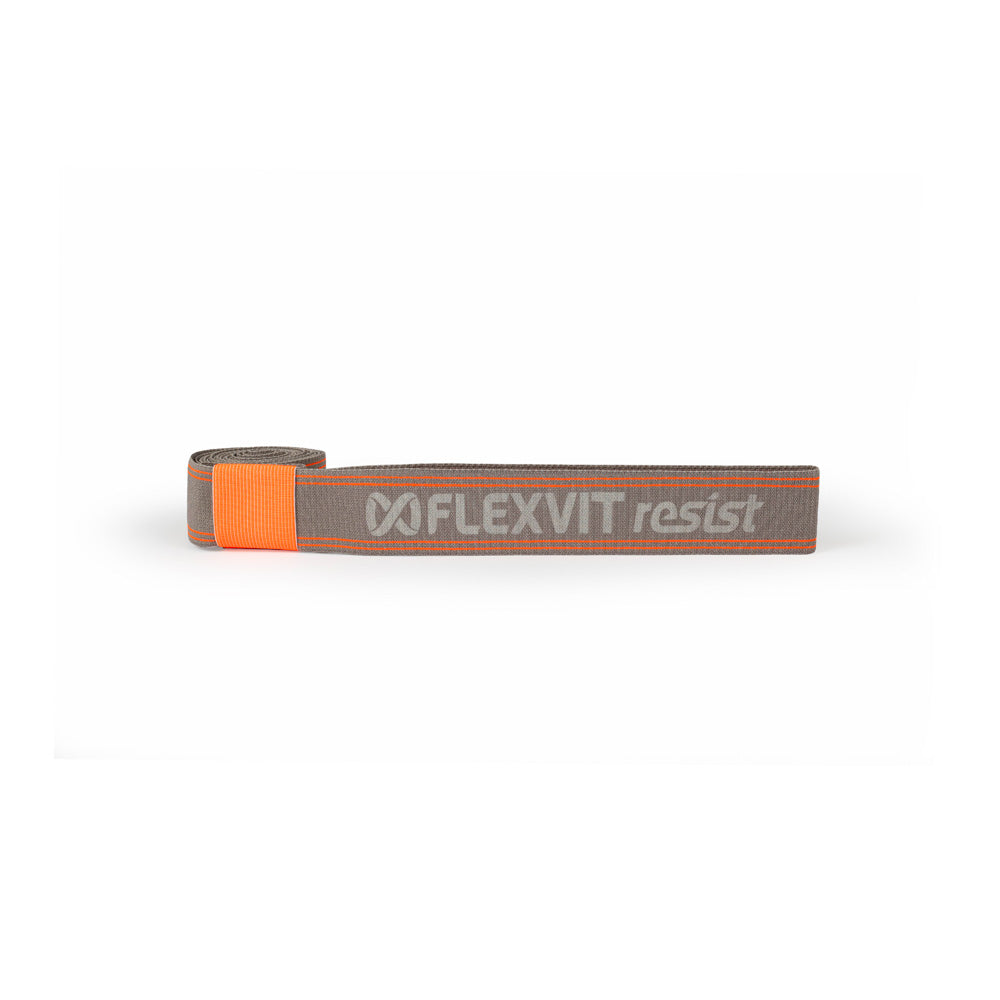
Our resistance bands consist of a specially developed combination of:
- Natural rubber
- Polyester fibers
We deliberately avoid classic plasticizers.
This material combination offers several crucial advantages:
- High elasticity
- Controlled stretch behavior
- Pleasant feel
- High resistance
- Long lifespan
The textile casing additionally improves:
- Skin feel and grip
- Control during dynamic movements
- Safety during training
- Robustness against abrasion and sweat
Especially in professional use—such as in physiotherapy, athletic training, or daily gym application—these properties are crucial for the long-term resilience of a product.
Made in Germany — Precision Instead of Mass Production
The quality of a resistance band is not solely determined by the material. The production process is equally crucial.
FLEXVIT deliberately produces in Germany. This not only represents a promise of quality but also the opportunity to precisely control and continuously develop every production step.

This includes, among other things:
- Precisely coordinated machine parameters
- Precise control of tension and material processing
- Extensive quality controls
- Manual processing steps
- Hand-sewn bands
This combination of technical precision and manual processing enables a level of consistency that is hardly achievable with standardized mass production.
Regular tests and controls additionally ensure the long-term durability of our products.
Insights into production:
Durability is Measurable
In professional use, a resistance band must reliably withstand thousands of stress cycles.
Therefore, we regularly test our bands under realistic load conditions—including repeated stretches over long periods.
Of course, we also compare products from other manufacturers.
One result always becomes clear:
Many resistance bands noticeably lose their elasticity and their original resistance behavior after a relatively short period of use.
At FLEXVIT, on the other hand, the long-term consistency of the material is paramount.
Even after thousands of stretching cycles, our bands retain their characteristic properties significantly more stably:
- Consistent tension
- Controlled recoil behavior
- Consistent resistance progression
- Reproducible load
Especially for professional users, this consistency is crucial. Because only a reproducible resistance allows for reliable load control.
Why Stretch Behavior is Crucial
The quality of a resistance band is not only evident in its durability but, above all, in its behavior under load.
The so-called force-displacement curve is crucial—i.e., the question:
How does the resistance change during stretching?
There are significant differences here between various products.
With inferior bands, problematic resistance profiles often occur:
- The band becomes very heavy with minimal stretch and then hardly increases resistance.
- Or the resistance initially remains low and then increases sharply and abruptly.
Both make controlled movement execution considerably more difficult.

FLEXVIT therefore pursues a different approach:
The resistance should increase evenly, controllably, and continuously with increasing stretch.
This optimized stretch behavior enables:
- More precise movement control
- Controlled force development
- Smoother movement sequences
- Better dosage of load
- Higher safety in dynamic movements
Especially in explosive or coordinatively demanding applications, this property plays a central role.
Control, Safety, and Movement
The quality of stretch behavior influences far more than just the subjective training sensation.
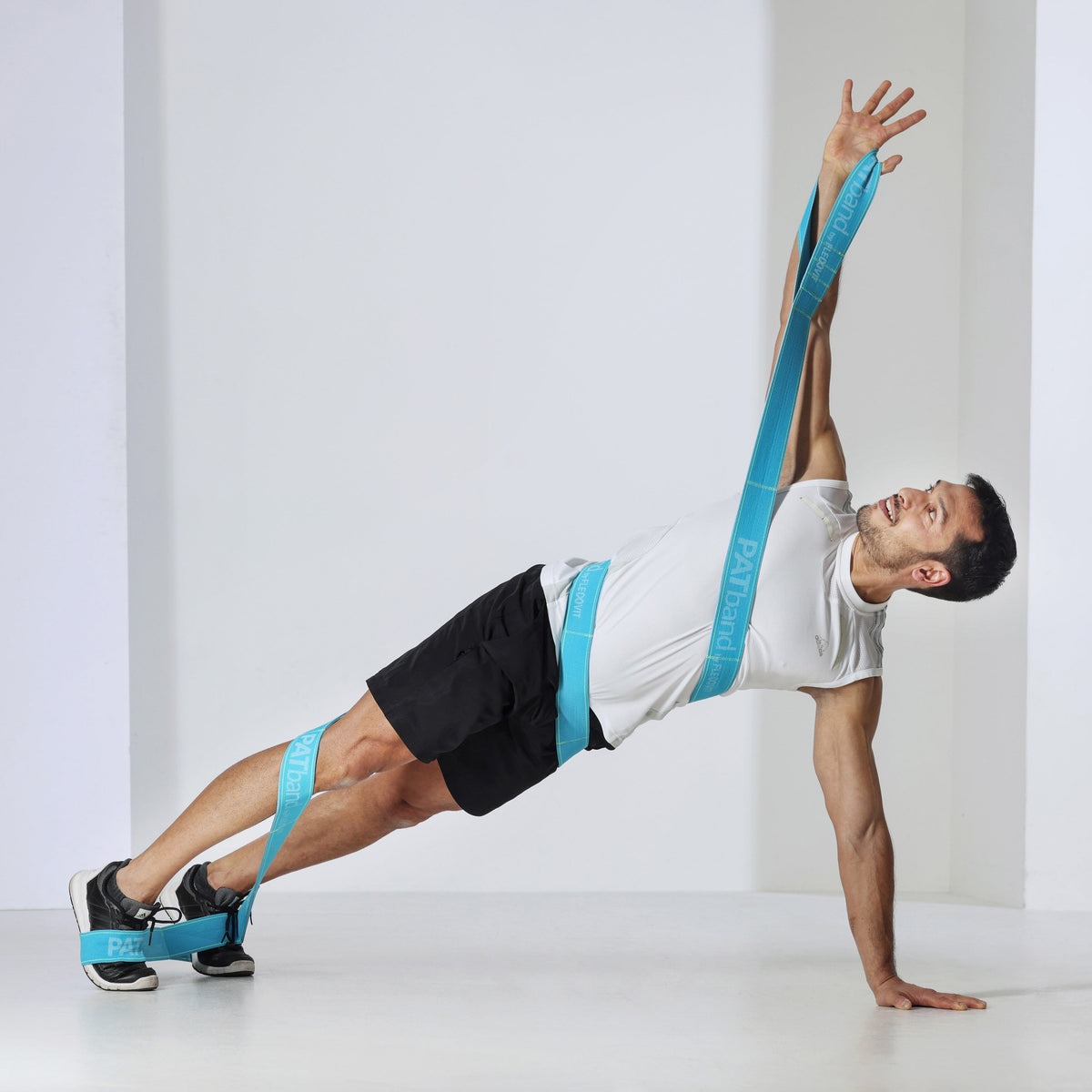
It determines how precisely movements can be controlled—especially in:
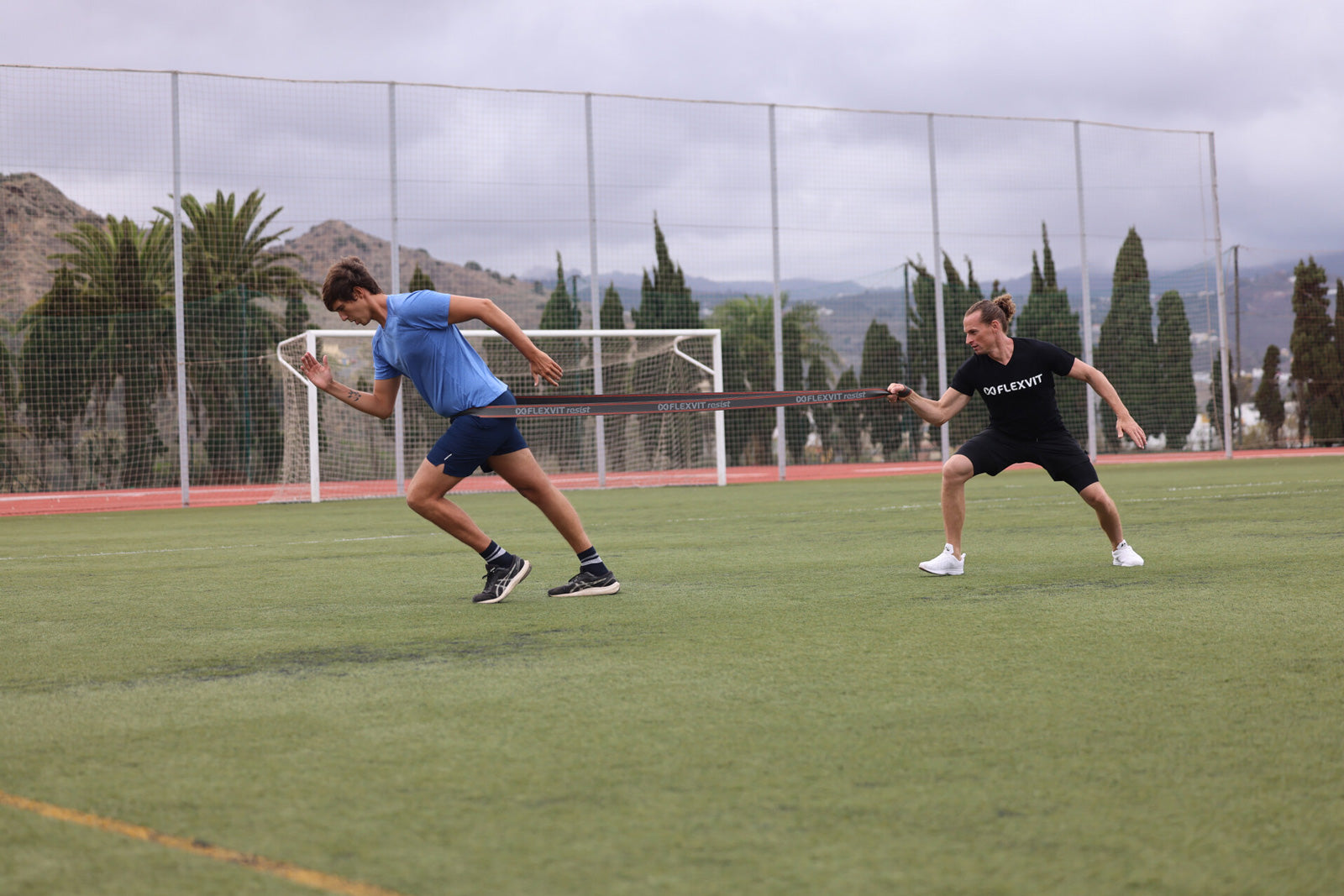
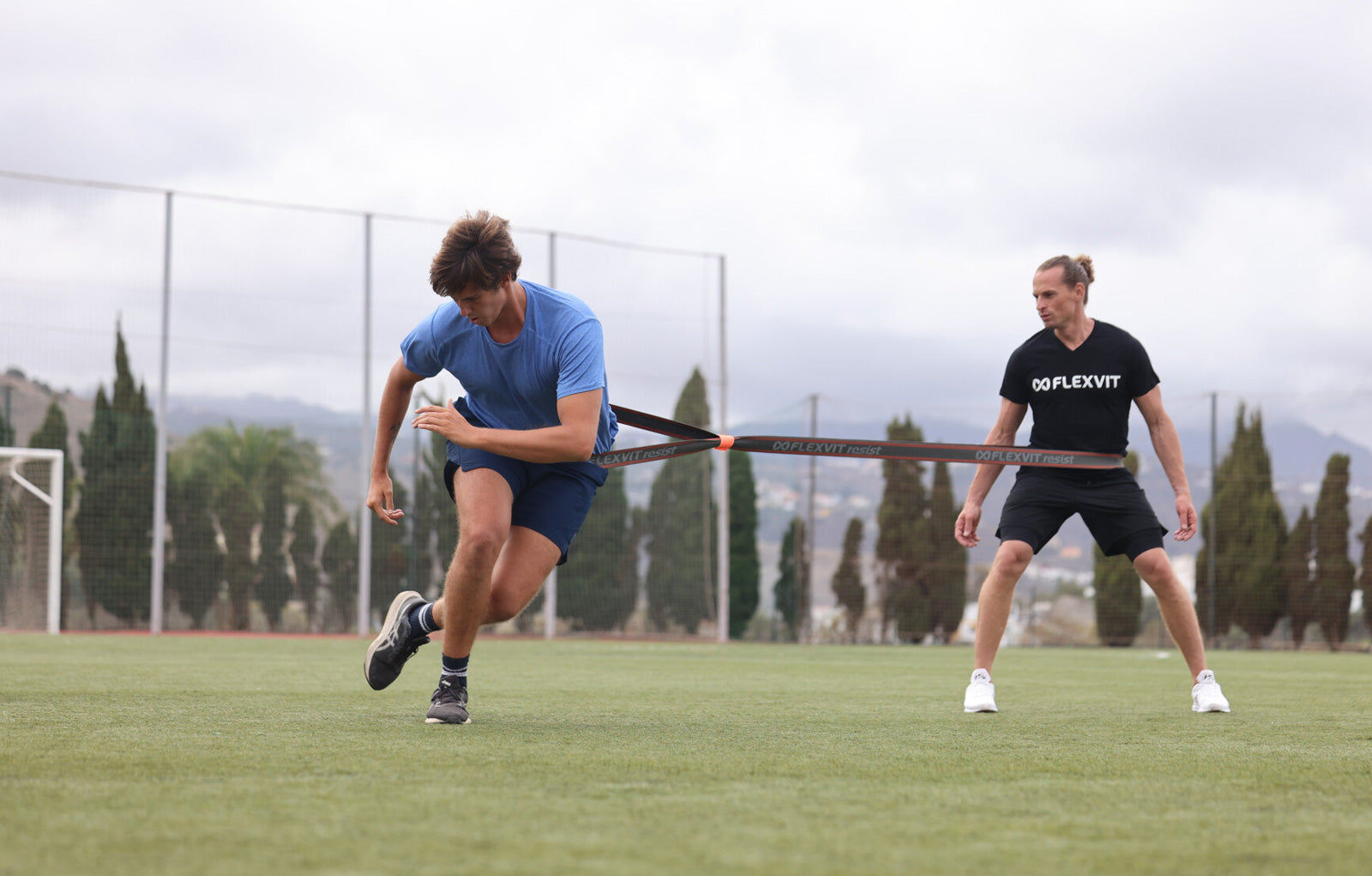
- Resisted sprints
- Jump training
- Rotational movements
- Rehabilitation exercises
- Sport-specific movement patterns
Abrupt or uneven resistance behavior makes controlling joint positions and movement dynamics difficult.
A steady increase in resistance, on the other hand, supports:
- Stable movement guidance
- Controlled eccentric movement
- Coordinative precision
- Continuous feedback during movement
Additionally, there is the tactile component.
The textile surface of the FLEXVIT bands provides:
- Pleasant feel
- High grip
- Improved sense of security
- More precise perception of movement
Especially in complex or fast movements, these sensory information are a relevant factor for movement control and load safety.
Control from a Neuroathletic Perspective
These aspects also play an important role in neuroathletic training.
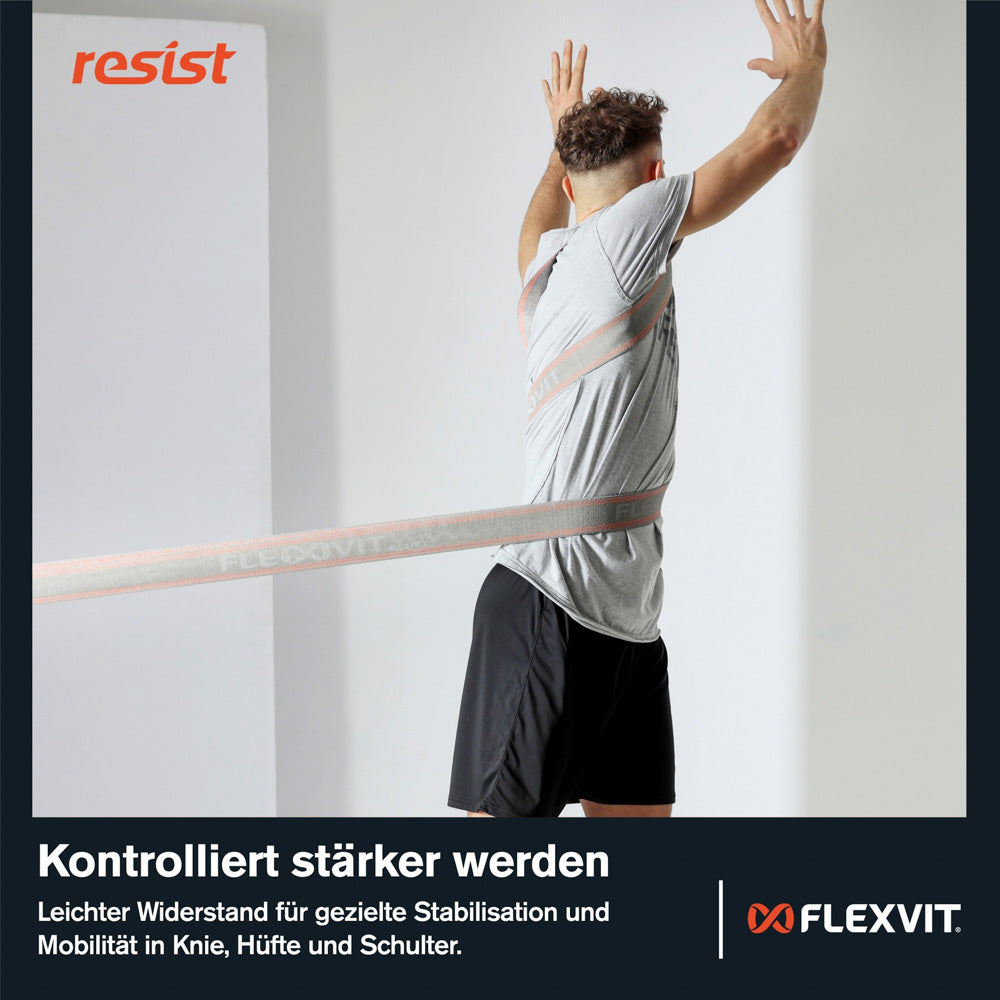
Athletic trainer Lars Lienhard describes the advantage of elastic resistances primarily through the factor of control:
"Personally, what I particularly like about the FLEXVIT bands is one thing: these bands provide the best possible control I've encountered in my coaching career, both when I stretch them and when I release them."
Neuroathletic training aims to purposefully connect movement, perception, and neural processes.
Elastic resistances offer several advantages for this:
- Continuous sensory feedback
- High freedom of movement
- Safe loading of large movement amplitudes
- Reflexive stabilization requirements
- Controlled eccentric loading
This allows complex and sport-specific movements to be trained with high control.
We also incorporate these principles in our course on Banded Neuroathletic Training.
Quality as the Foundation of Modern Training Systems
With the increasing importance of elastic resistances, the responsibility for their quality also grows.

In professional training, it is not enough for a band to merely "work."
Crucial aspects are:
- Reproducible load
- Controlled stretch behavior
- Long-term material stability
- Safety under load
- Precise movement feedback
Therefore, FLEXVIT understands resistance bands not as simple accessories, but as precise training tools within modern training systems.
Our Conclusion — Quality Shows in Movement
The quality of a resistance band is not apparent at first glance.
It reveals itself:
- After thousands of load cycles
- In the control of complex movements
- In the even progression of resistance
- In the safety of dynamic loads
- In the precision of the training sensation
FLEXVIT therefore pursues a consistently quality-oriented approach:
- High-quality materials
- Controlled production in Germany
- Precise processing
- Continuous testing
- Optimized stretch behavior
The goal is not simply the production of elastic resistances.
The goal is the development of resistance bands that permanently meet modern demands in therapy, training, and competitive sports.
______
FAQ — Frequently Asked Questions about High-Quality Resistance Bands
What truly matters for high-quality resistance bands?
-
Material quality
-
Stretch behavior
-
Durability
-
Production quality
Why do resistance bands differ so much in quality?
-
Material composition
-
Production process
-
Elasticity
-
Recoil behavior
-
Load stability
What makes FLEXVIT bands special?
-
Natural rubber
-
Textile polyester fibers
-
Precise production processes
-
Controlled manufacturing in Germany
-
High durability
-
Controlled stretch behavior
-
Pleasant feel
-
high safety
-
reproducible load
Why does FLEXVIT produce in Germany?
-
precisely coordinated machines
-
continuous material checks
-
regular load tests
-
manual processing steps
-
hand-stitched bands
Why is the stretch behavior of a resistance band so important?
-
immediately very high resistance
-
abrupt increase in tension
-
uncontrolled return behavior
-
movement quality
-
control
-
safety
-
load dosage
Why is a consistent resistance curve important?
-
controlled force development
-
smoother movements
-
better movement control
-
safer eccentric loading
-
more precise training control
-
sprint training
-
jump training
-
rehabilitation
-
athletic training
-
sport-specific movements
Are textile resistance bands better than classic rubber bands?
-
higher robustness
-
more pleasant feel
-
better control
-
higher safety
-
lower risk of material fatigue
-
more consistent stretch behavior
Why do FLEXVIT bands not use plasticizers?
-
material properties remain more stable
-
elasticity is maintained long-term
-
aging processes are reduced
-
stretch behavior is more controllable
How does FLEXVIT test the quality of its resistance bands?
Why is control so important with resistance bands?
-
joint stability
-
movement quality
-
coordinative precision
-
safety in dynamic movements
Why are FLEXVIT bands used in neuro-athletic training?
-
continuous feedback
-
large ranges of motion
-
controlled eccentrics
-
reflexive stabilization work
-
sport-specific movement patterns
For which applications are FLEXVIT resistance bands particularly suitable?
-
strength training
-
athletic training
-
rehabilitation
-
physiotherapy
-
sprint and jump training
-
mobility training
-
neuro-athletic training
-
functional training
Why are FLEXVIT bands considered particularly durable?
-
high-quality material selection
-
textile construction
-
precise manufacturing
-
controlled production
-
regular quality checks
What distinguishes professional resistance bands from inexpensive fitness bands?
-
reproducible resistance
-
controlled elasticity
-
higher material quality
-
better safety
-
longer durability
-
more precise load control
What role does FLEXVIT play in modern band training?
-
high-quality materials
-
German production
-
scientifically-oriented training approaches
-
practice-oriented application systems